Panic Attacks: What Helps in the Moment and Long Term
What a panic attack is, what to do during one, how panic disorder is treated in the UK, how CBT helps, and when chest pain or other symptoms need urgent care.

How counselling and talking therapies help with depression, what NICE recommends, NHS and private routes in the UK, and when to get urgent help.
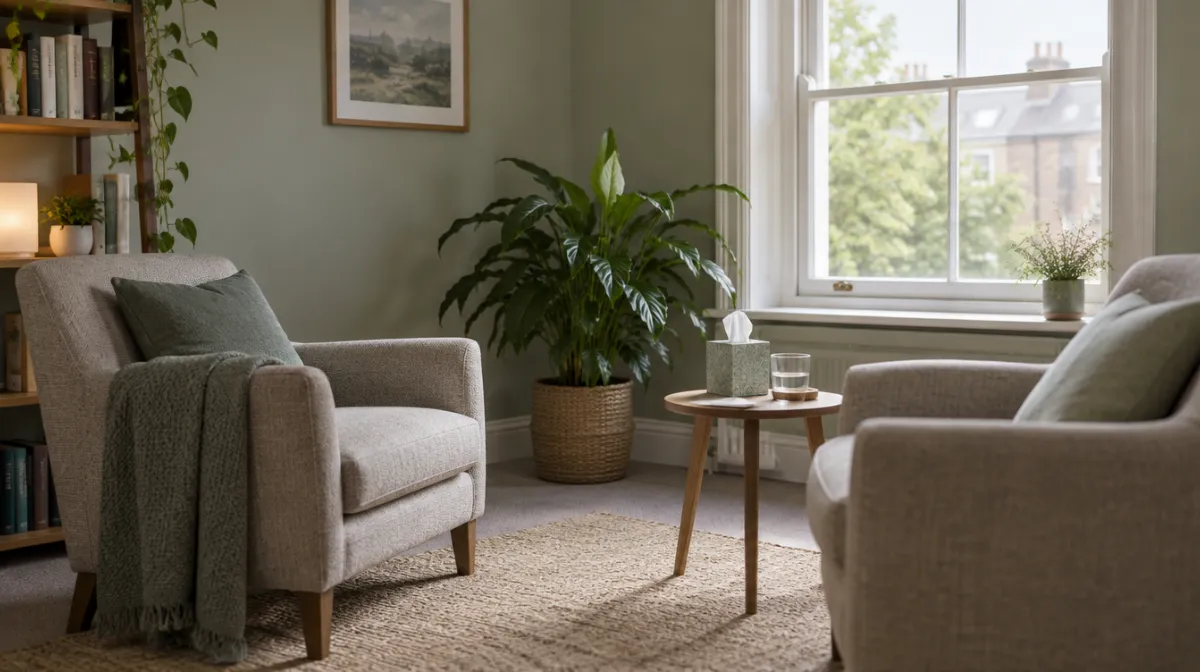
Depression is more than feeling sad for a few days. It’s a persistent low mood or loss of interest that affects how you think, sleep, eat and get through the day. The good news is that it’s treatable, and talking therapies, including counselling, help many people recover. In the UK, you can get talking therapy through the NHS (in England, often by referring yourself) or privately, and your GP can talk you through all the options, including medication.
The NHS describes symptoms that last for at least two weeks and affect daily life. They can include:
Depression can be mild, moderate or severe, and it can follow a difficult event or appear without an obvious cause. If several of these sound familiar, it’s worth speaking to your GP. Our guide to signs you might benefit from counselling covers wider reasons to seek support.
Therapy gives you regular, protected time with a trained professional to make sense of what’s happening and find ways forward. Depending on the approach, you might:
NICE’s guideline on depression in adults (NG222) sets out a menu of treatments and says the choice should be made together with you, taking into account your preferences, past experiences of treatment and the severity of your depression. Options include:
| Treatment | What it involves |
|---|---|
| Guided self-help | Working through structured materials with support from a practitioner |
| Cognitive behavioural therapy (CBT) | Changing unhelpful thought and behaviour patterns, individually or in a group |
| Behavioural activation | Rebuilding activity and routine to lift mood |
| Interpersonal therapy (IPT) | Focusing on relationships and life changes |
| Counselling | Talking through problems in a supportive relationship; NICE suggests considering it particularly where relationship, work or other life problems are involved |
| Short-term psychodynamic psychotherapy | Exploring how past experiences and patterns affect you now |
| Group exercise and group mindfulness | Structured activity or meditation programmes with others |
| Antidepressants | Medication, sometimes combined with therapy |
For more severe depression, NICE highlights a combination of individual CBT and an antidepressant as an effective option, among others. Our guides to CBT and psychodynamic therapy explain two of these approaches in detail.
Within NHS Talking Therapies in England, one of the approaches offered is Counselling for Depression, a structured form of person-centred, experiential counselling developed specifically for depression. It focuses on your feelings and experience, and on building your own understanding and resources. If you like the idea of a warm, non-directive approach, our guide to person-centred therapy explains the ideas behind it.
| Route | How to access | Things to know |
|---|---|---|
| NHS Talking Therapies (England) | Refer yourself online or through your GP | Free; waiting times vary by area; a short assessment first |
| Your GP | Book an appointment | Can refer you, discuss medication and check for physical causes |
| Wales, Scotland and Northern Ireland | Usually through your GP or local services | Services and names differ by nation |
| Workplace schemes | Employee assistance programme (EAP) | A few free sessions, often quickly; see workplace counselling and EAPs |
| Private counselling | Contact a registered counsellor directly | Choice and speed, but you pay per session; see counselling costs in the UK |
When choosing privately, look for a counsellor on a register accredited by the Professional Standards Authority, such as those held by BACP, UKCP or NCPS. Our guide to finding a counsellor in the UK explains how to check.
Sessions usually last about 50 minutes, weekly, for a set number of weeks or longer. In the first session you’ll talk about what’s been happening, what you’d like to change and how you’ll work together. It’s normal to feel tired or emotional afterwards, especially at first. Progress isn’t always steady; many people notice small changes before bigger ones.
If you feel unable to keep yourself safe, call 999 or go to A&E. You can call Samaritans free on 116 123, any time, or text SHOUT to 85258. In England, call NHS 111 and choose the mental health option.
For many people, yes, particularly with less severe depression. For more severe depression, therapy combined with medication is often recommended. Your GP can talk through what suits you.
It varies. NHS courses are often around 6 to 20 sessions depending on the approach, while private counselling can be shorter or longer.
That’s common with depression. A good counsellor will go at your pace, and it’s fine to say you’re finding it hard to talk.

Every article is edited by a human and checked against our editorial policy. Spotted a mistake? Tell us.
What a panic attack is, what to do during one, how panic disorder is treated in the UK, how CBT helps, and when chest pain or other symptoms need urgent care.
Therapy options after trauma in the UK: trauma-focused CBT, EMDR and other approaches, what NICE recommends for PTSD and complex PTSD, and how to find support.
Counselling, therapy and psychotherapy overlap, but they are not identical. What each involves, who provides it in the UK and how to choose what suits you.